Scaffolding is a useful construction trade that provides job opportunities in Nepal as well as abroad. With increasing construction, infrastructure, and industrial projects requiring skilled labor, the need for trained scaffolders arises in order to ensure safety while working at heights.
If you are someone who is interested in technical jobs, then Scaffolder in Nepal could prove to be a good choice. But getting an overseas job takes much more than just physical fitness.
Workers will require skills, safety knowledge, proper training, and knowledge of the recruitment process. This manual covers the duties of a Scaffolder in Nepal, the skills and training needed, overseas destinations, and how to apply via the recruitment process.
What Does a Scaffolder in Nepal Do?
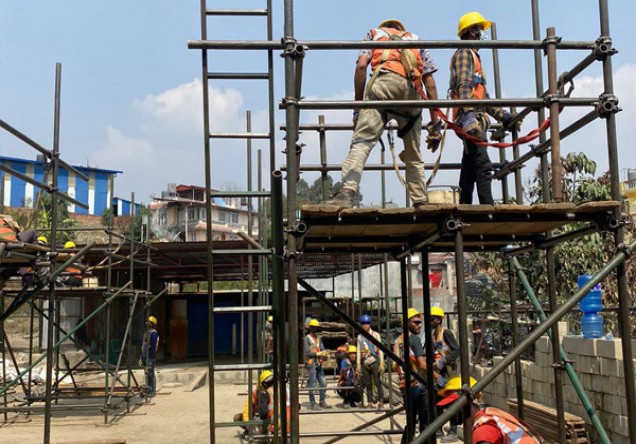
The Scaffolder in Nepal erects, modifies, and deconstructs temporary frameworks that enable construction workers to work at heights safely. Such frameworks are known as scaffolds. Scaffolds create work platforms and support workers, equipment, and materials during construction or repair.
Scaffolders work on different types of projects, including:
Building construction: Setting up scaffolds for wall construction, painting, plastering, and other work at height.
Industrial plants: Providing access for maintenance, repairs, and installation work.
Infrastructure projects: Supporting construction activities on bridges, roads, power facilities, and other large structures.
The job requires constructing scaffolding tubes, frames, platforms, couplers, and other materials according to the design and site requirements. Stability of the structure must be ensured prior to its use.
An experienced scaffolder in Nepal should know the connections between different scaffold parts and the safety protocol that is needed for each site. It is very important to be cautious because a poorly constructed scaffold may endanger several people.
Why Scaffolders Are in Demand Overseas
Construction and industrial projects in the Gulf countries create opportunities for workers with practical scaffolding experience. Large buildings, factories, oil and gas facilities, and infrastructure developments often need temporary access structures for construction and maintenance.
This provides room for a qualified Scaffolder in Nepal who can adhere to technical guidance, work at height, and work alongside other construction teams. The employers usually prefer to employ people who are knowledgeable about the scaffold structure and have hands-on experience in the field.
World Net Recruitment has previously published a demand for 22 scaffolders in Qatar through its recruitment listings. However, this particular vacancy had a deadline for applications of 18 October 2026, and thus it is no longer relevant.
This is just an example of the kind of demand that can come up in the course of work abroad. Applicants should take note of the latest vacancies and the application deadline.
Overseas recruitment depends on employer requirements, project schedules, and approved job orders. Therefore, a Scaffolder in Nepal should not assume that a previous vacancy will be available again. Checking current demand through a licensed recruitment agency is an important step.
Skills Every Scaffolder Needs
Scaffolding requires practical ability, attention to detail, and a strong understanding of workplace safety. A Scaffolder in Nepal should develop the following skills before applying for construction jobs.
Basic technical understanding: Employees need to be familiar with scaffold parts such as tubes, couplers, frames, bracing, base plates, and platforms. They must also have basic knowledge of instructions, measurements, and scaffold drawings when necessary.
Tool and equipment handling: Scaffolders use tools and fittings to assemble and dismantle structures. They need to handle equipment correctly and keep materials organised at the worksite.
Physical fitness and balance: The job involves lifting, carrying, climbing, and working in different positions. Good physical fitness and balance help workers perform these tasks safely.
Teamwork and communication: Scaffolding is rarely completed by one person. Workers must communicate with supervisors and other team members, follow instructions, and coordinate their work.
Working at height: A Scaffolder in Nepal must understand the risks of working above ground level. They should follow site rules, use the required protective equipment, and avoid unsafe shortcuts.
In addition, employers can evaluate the candidate’s skills in working under supervision, following instructions in English and accomplishing tasks according to the required safety standards.
Scaffolding Training in Nepal
Practical training can help candidates understand the equipment, techniques, and safety procedures used in scaffolding work. World Net Recruitment provides construction-related training through its associated World Net Skill Training Center. Scaffolding is included among the technical training programmes listed by the organisation.
The training is intended to help a Scaffolder in Nepal develop practical knowledge before entering the construction workforce. The listed training areas include:
- Technical skills: Understanding scaffold structures, components, and basic assembly methods.
- Tool and equipment handling: Learning how to use and manage scaffolding tools and fittings.
- Workplace safety: Understanding the risks associated with construction work and working at height.
- Practical knowledge: Developing familiarity with the tasks involved in setting up and dismantling temporary structures.
- Course certification: Receiving a certificate after completing the training programme.
According to World Net, the training programs of the firm usually take a few weeks to a few months. The exact duration of the training program, practical schedule, and application requirements will be obtained from the training center.
The organisation lists its main office in Kathmandu and a Pathibhara Training Center in Damak. However, candidates should contact the centre to confirm whether the scaffolding course is currently available at both locations. Training availability and schedules may change.
Course completion is useful for a scaffolder in Nepal, laying the groundwork for starting at the entry-level stage. Nevertheless, a training certificate does not necessarily guarantee employment abroad. There could be other requirements like relevant experience and assessment tests.
Requirements to Become a Scaffolder in Nepal
The qualification criteria for scaffolders may differ according to the employer, projects, and destination country. Before making an application, a Scaffolder in Nepal needs to know about the essential documentation and selection process for overseas recruitment.
Common documents and requirements may include:
- A valid passport.
- Nepali citizenship certificate or other required identity documents.
- Recent photographs and personal details.
- Medical examination results from an approved medical centre, when required.
- Training certificates or other proof of relevant skills.
- Work experience documents, if the employer requires previous experience.
This is a general list of documents and not a fixed list of documents to be provided for each vacancy. Some employers may require extra documents or experience. The candidates need to verify the exact requirements from the official job advertisement and recruitment agency.
A Scaffolder in Nepal might be required to go for an interview or practical test. An employer will determine whether candidates have knowledge of scaffolding parts and whether they can follow instructions and complete simple tasks. There could be a trade test in some cases.
Preparation for these tests will help the applicant gain more confidence. Study key terminology used in scaffolding, know safety precautions and be prepared to discuss your experience in the field.
Career Path and Growth
Scaffolding can offer different career opportunities as workers gain practical experience. A person beginning as an assistant may gain skills required for handling complex assignments slowly but surely. Given the right kind of experience and training, a Scaffolder in Nepal can progress to more responsible roles.
A general career path may include:
Scaffolding helper: Assisting experienced workers with carrying materials, organising equipment, and preparing work areas.
Skilled scaffolder: Assembling, modifying, and dismantling scaffold structures according to instructions and safety procedures.
Experienced scaffolder: Handling more complex assignments and supporting other team members.
Scaffolding supervisor: Coordinating workers, checking work progress, and helping ensure that site procedures are followed.
The actual career path depends on experience, employer requirements, technical ability, and additional qualifications. There are also opportunities for a Scaffolder in Nepal in the local construction industry.
Private firms, infrastructure firms, semi-government organizations, as well as NGOs/INGOs, may need people with construction skills. Experienced individuals can even try going solo or contracting in some way, according to their own qualifications and business arrangements.
Safety on the Job
Safety is an extremely important aspect of scaffold erection work. The scaffold should be erected, checked, and used in accordance with the requirements of the construction site. Even the slightest error can cause a fall or structural failure.
A trained Scaffolder in Nepal should follow basic safety practices throughout the job.
Wear protective equipment: Use the required helmet, safety footwear, gloves, and fall protection equipment.
Use a suitable harness: Where required by the site risk assessment and safety procedures, use a properly fitted safety harness with an approved attachment system.
Inspect components: Check scaffold tubes, couplers, platforms, braces, and other parts for damage before use.
Follow approved instructions: Build and change scaffolds according to the approved design and instructions from authorised supervisors.
Keep platforms organised: Avoid leaving loose tools or materials where they could create a trip or falling-object hazard.
Report unsafe conditions: Inform the supervisor if a scaffold appears unstable or any component is damaged.
A scaffolder in Nepal must never use an unfinished or unsafe structure to save time. Appropriate training makes it possible for workers to identify risks and understand the processes involved in staying safe.
Overseas Job Opportunities for Scaffolders
Various countries look for construction and manufacturing workers in Nepal. Some of the Gulf countries where scaffolding jobs could be found include the UAE, Qatar, Saudi Arabia, Oman, and Kuwait. Construction and maintenance occupations could be found in Malaysia as well.
The opportunities available to a Scaffolder in Nepal will be based on the requirements of the employer's workforce and the vacancies available. In some projects, there is a requirement for labor in constructing buildings. In other cases, there could be a need for industrial scaffolding.
Employers generally look for candidates who can:
- Understand basic scaffolding techniques and components.
- Follow technical instructions and workplace safety rules.
- Work comfortably as part of a construction team.
- Handle tools and equipment correctly.
- Demonstrate relevant practical experience or training.
- Communicate clearly with supervisors and coworkers.
Job adverts can list requirements including experience, age, qualifications, medical fitness, language abilities, and more. Applicants must take notice of such requirements before making an application.
A Scaffolder in Nepal should also understand that job availability changes over time. A recruitment agency may publish a demand for a specific number of workers. Still, the opening remains subject to its application deadline, employer selection, and official approval. Always check whether the vacancy is still open and whether the job details match the approved demand.
How the Recruitment Process Works
Applying for an overseas job involves several steps. World Net Recruitment follows an eight-step recruitment process that covers candidate sourcing, screening, assessment, selection, and deployment support.
Here is how a Scaffolder in Nepal can understand and prepare for each stage.
1. Needs analysis: Recruitment staff members consider the needs of the employer, which include the number of employees required, duties, experience, and qualifications. As an applicant, go through the vacancy notice and see whether you meet the requirements stipulated.
2. Candidate sourcing: Identification of suitable candidates is made through the recruitment process. You are able to fill in an application form and give precise details about yourself.
3. Screening: The agency examines your application to ensure that you meet the requirements of the job position. Make sure your application is complete and correct.
4. Interview and testing: An interview, evaluation of skills, or trade test may be performed by the employer or the recruiting team. You should be ready to talk about your background and showcase your skills.
5. Selection: The employer screens the short-listed individuals and makes the final choice. Selection is based on the criteria of the employer, not just on having completed training or having applied.
6. Visa assistance: The recruitment team assists you in obtaining visa-related documents after selection. Go through all the details and ensure the employment information is accurate.
7. Pre-departure preparation: Some workers receive orientation about traveling, workplace, and the processes to be followed before leaving Nepal. Attend the orientation process and complete the formalities.
8. Placement and ongoing support: The individual will travel for the approved job and begin work on the basis of the employment contract. You should retain copies of all pertinent documents and approach the official bodies in case you encounter a problem.
This knowledge will help a Scaffolder in Nepal be prepared for the process and what to expect at every step. Do not hesitate to ask any questions if anything about the job offer, contract, or payment terms is not clear.
Avoiding Recruitment Scams
Foreign employment may offer great chances, but candidates must verify information regarding the recruitment before committing themselves. The job seeker in Nepal must never depend on social media ads and oral promises while seeking employment abroad.
Use these checks to protect yourself:
Verify the licence: Ask for the recruitment agency's government licence number and check its current status through the Department of Foreign Employment.
Check the company details: Confirm that the agency name, address, and contact information match the official records.
Review certifications: If an agency claims to hold ISO certification, ask to see the certificate and check its validity and scope. ISO certification does not replace a government recruitment licence.
Read the job documents: Check the employer's name, job title, salary, working hours, benefits, contract period, and other conditions.
Ask for written information: Keep copies of the job offer, contract, receipts, and other documents related to your application.
Be careful with guarantees: No agency should promise that every applicant will receive a job or visa. Final selection depends on the employer and the required approvals.
The candidates may make use of the official website of the Department of Foreign Employment to find out the recruitment information. One should not give money and/or documents to any unauthorized person. A proper verification process is helpful for a Scaffolder in Nepal before deciding to go abroad.
Why Choose World Net Recruitment for a Scaffolder in Nepal Career?
Choosing a recruitment agency is an important decision when preparing for overseas employment. World Net Recruitment Consultants has been operating since July 2000 and states that it has more than 26 years of recruitment experience. The company operates under Government Licence No. 174/056/057 and lists ISO 9001:2015 certification.
World Net works in overseas recruitment and skills training through its associated training centre. Its listed training programmes include scaffolding and other construction-related trades. This combination can help candidates explore skill development and recruitment services through the same organisation.
In the case of Scaffolder in Nepal, recruitment is supported in varying phases, such as pre-screening, interviews, selection tests, visa processing, departure preparations, and placement support. The services offered will depend on the requirements of the job and needs of the candidate.
World Net Recruitment operates from Chandol-04, Kathmandu. The company's working hours are from 10:00 AM to 5:00 PM, Sunday to Friday. Candidates who want training or employment abroad can contact the organization for details on current training programs and scaffolding demands.
If you are considering a career as a Scaffolder in Nepal, contact World Net Recruitment to discuss your training and overseas employment options.
Phone: +977-1-4540978
Email: info@worldnetrecruitment.com
Conclusion
Career building in scaffolding involves practical training, technical expertise, physical conditioning, and a commitment to safety in the workplace. Job applicants need to be aware of what is expected of them and acquire the necessary skills before applying for jobs overseas.
As a Scaffolder in Nepal, the hiring process for jobs abroad becomes much easier and more secure by going through a proper recruitment agency and examining all job particulars. Make sure you research the various training programs, check job vacancies currently available, and then sign the employment contract.
FAQs
1. How do I become a scaffolder in Nepal?
If you wish to become a scaffolder in Nepal, then first you need to learn basic skills relating to scaffolding. This will involve getting trained in construction as well as the use of machinery and equipment. After acquiring the necessary skills, look for available jobs in construction and apply to a recruitment agency if you intend to work abroad.
2. How long is scaffolding training?
The duration depends on the training programme and its practical requirements. World Net states that most of its construction training courses take a few weeks to a few months. Candidates who complete a programme receive a certificate. Contact World Net Skill Training Center for current scaffolding course dates, duration, and admission details.
3. What documents do I need to apply for scaffolder jobs abroad?
Common requirements can range from a valid passport to a citizen card, photographs, results of medical test, and evidence of training/work experience. Nevertheless, the exact list of documents will depend on the employer and destination state. It is advisable to examine the advertised employment opportunity for more information.
4. Which countries hire scaffolders from Nepal?
Job openings related to scaffolding could exist in countries like the United Arab Emirates, Qatar, Saudi Arabia, Oman, Kuwait, and Malaysia. The availability of job openings depends on the needs of the organization and projects.
5. How do I check whether a manpower agency is genuine?
Obtain the government licence number of the recruitment agency from the Department of Foreign Employment. Verify its name and address, scrutinize the job papers, and request details in writing regarding the costs and terms of employment. Stay away from unauthorized agents and those who promise jobs or visas.
- What Does a Scaffolder in Nepal Do?
- Why Scaffolders Are in Demand Overseas
- Skills Every Scaffolder Needs
- Scaffolding Training in Nepal
- Requirements to Become a Scaffolder in Nepal
- Career Path and Growth
- Safety on the Job
- Overseas Job Opportunities for Scaffolders
- How the Recruitment Process Works
- Avoiding Recruitment Scams
- Why Choose World Net Recruitment for a Scaffolder in Nepal Career?
- Conclusion
- FAQs
- 1. How do I become a scaffolder in Nepal?
- 2. How long is scaffolding training?
- 3. What documents do I need to apply for scaffolder jobs abroad?
- 4. Which countries hire scaffolders from Nepal?
- 5. How do I check whether a manpower agency is genuine?